
Certificate lifecycle on autopilot.
Discover certificates across your network, automate issuance and renewal via ACME and Microsoft AD CS, and distribute to your entire infrastructure. One platform, relentless auto-renewal.
Everything you need for certificate management.
From issuance to distribution, CertAutoPilot handles the full certificate lifecycle with enterprise-grade security and compliance.
Certificate Lifecycle Automation
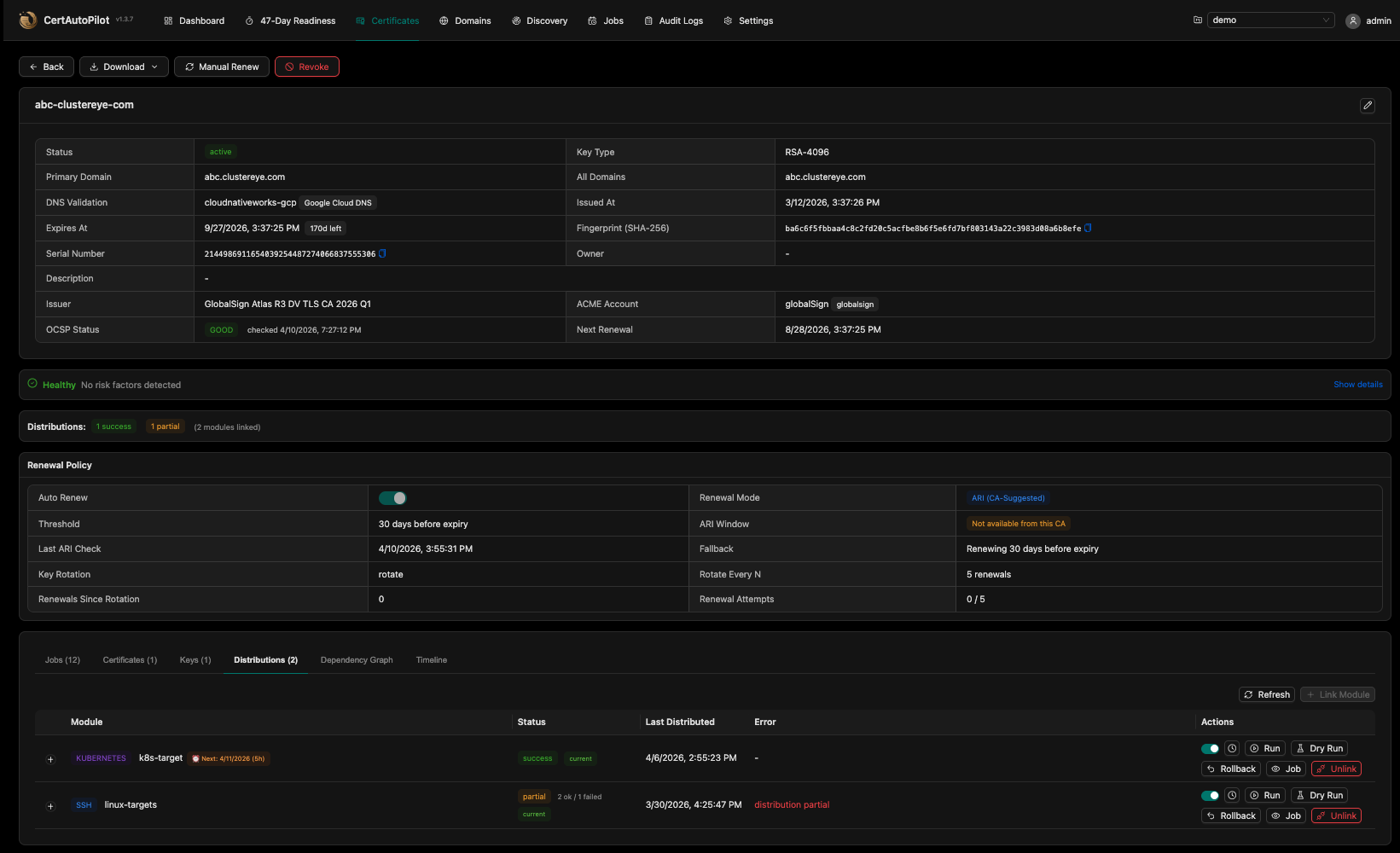
Automated issuance, renewal, and revocation via ACME v2 and Microsoft AD CS, validated by DNS-01 (automatic through 18 DNS providers), HTTP-01, or manual DNS, with ACME Renewal Information (ARI) honored on renewal. Supports Let's Encrypt, Google Trust Services, Sectigo, DigiCert, and more. Already have a certificate? Import externally-issued certs (bring-your-own) to distribute and track them alongside CA-managed ones. Managed certificates are continuously re-checked against OCSP and CRL, so a CA-side revocation is detected and alerted on.
Certificate Discovery
Scan networks, monitor CT logs, and pull hostnames from DNS zones (AXFR) and cloud DNS (Cloudflare, including proxied records, and Google Cloud DNS) to build a complete inventory. Automated security findings, drift detection, PQC assessment, and managed transition.
Multi-Target Distribution
Deploy certificates to 17 built-in targets with fan-out execution, dry-run validation, and versioned rollback on all 17 modules. Pick IIS sites and bindings, Kubernetes Secrets, Vault paths, Exchange servers, PAN-OS objects or cloud certificates (Azure Key Vault, AWS ACM, Cloudflare) straight from the live target, and preview which IIS bindings a deploy will touch. Agentless architecture — no agents to install.
Approval Workflows
Request/approve/reject flow with preflight warnings for certificate operations, configuration changes, and distribution actions. Self-approval blocked. Integrated with the notification system.
Multi-Tenant RBAC
Owner, Admin, Operator, Viewer hierarchy with project-scoped permissions. LDAP/AD integration, 2FA, JWT with refresh-token reuse detection.
Domain Monitoring
WHOIS expiry tracking, SPF/DMARC/DNSSEC/CAA health checks, and dangling-DNS takeover detection across your domain inventory.
Tamper-Proof Audit
HMAC-chain integrity verification on all audit entries. Event sourcing for complete certificate lifecycle timeline. Syslog forwarding in RFC 5424, CEF (ArcSight/Splunk), or LEEF (QRadar).
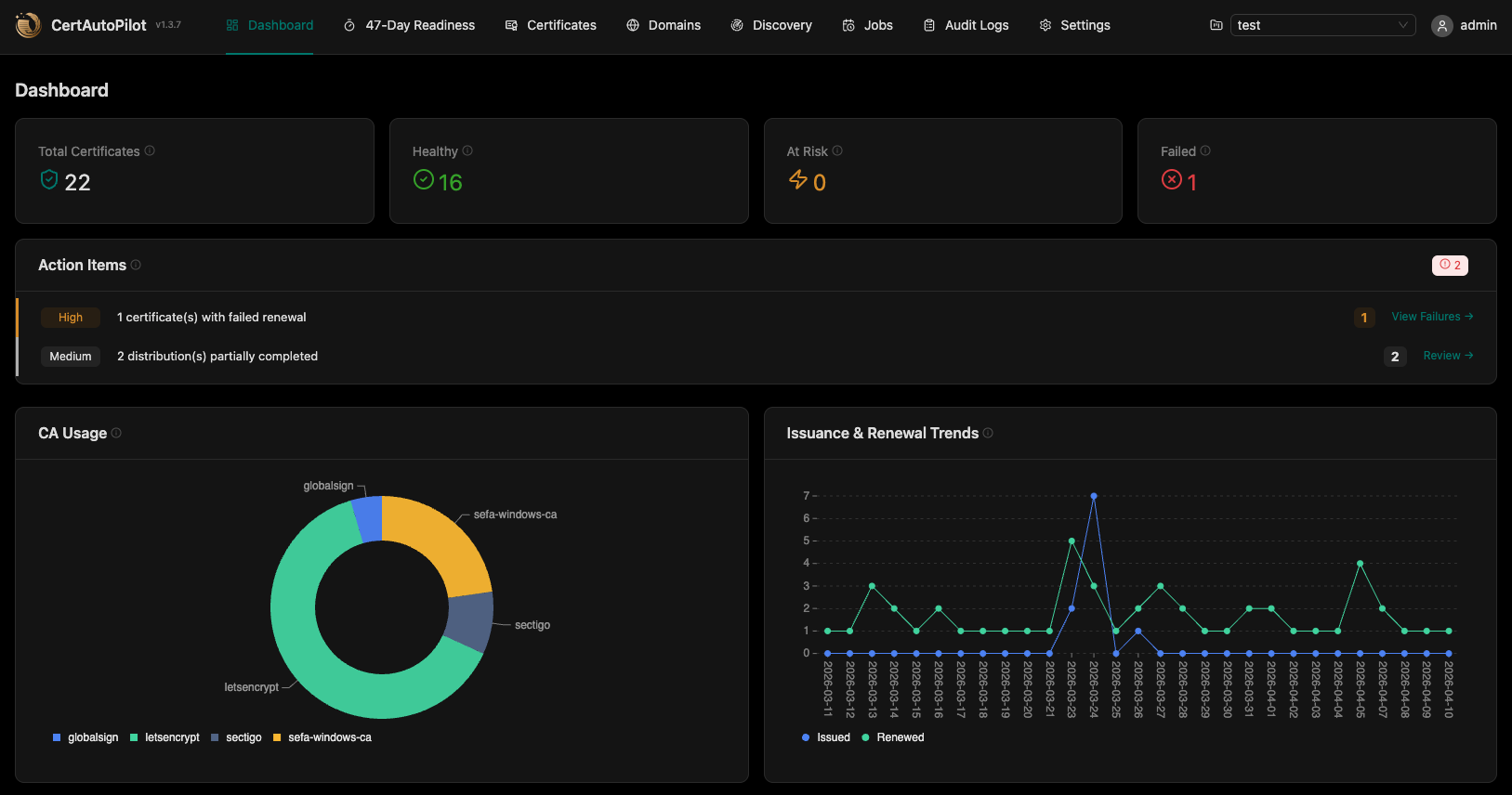
Dashboard & Observability
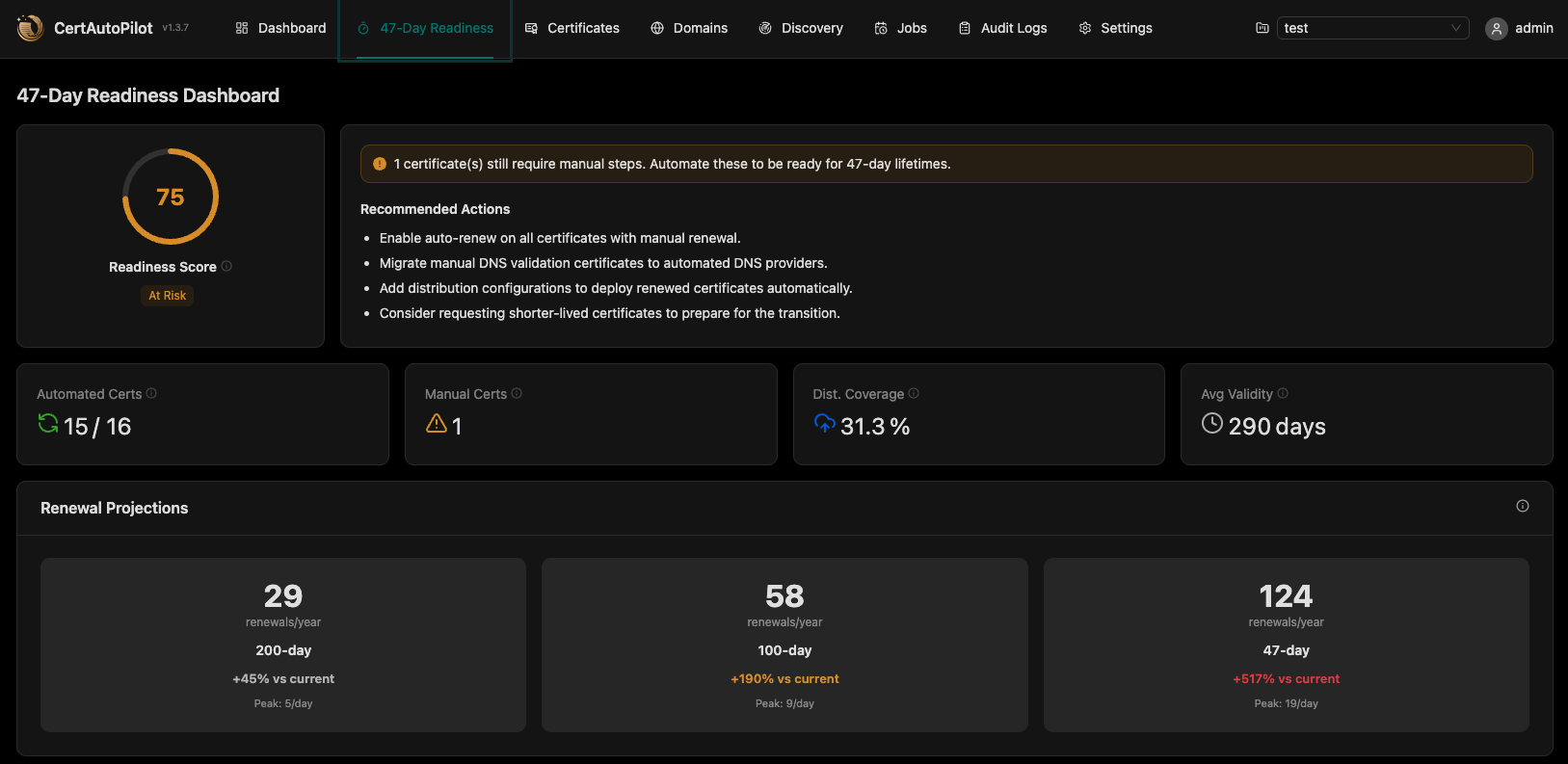
Prometheus metrics, OpenTelemetry tracing, and 47-day readiness scoring. CA usage breakdown, renewal trends, and live action items.
API & Automation
250+ REST API endpoints with JWT Bearer authentication, project-scoped RBAC, Go template variables, webhook events, and full CI/CD integration. Everything in the UI is in the API.
PQC Readiness
Classify Post-Quantum Cryptography readiness per certificate across your inventory. Identify which certs are vulnerable today and plan migration.
Envelope Encryption
AES-256-GCM with per-field DEK/KEK architecture. Private keys, credentials, and secrets encrypted at rest with versioned key management — or keep distribution credentials out entirely and read them live from HashiCorp Vault, OpenBao or ManageEngine PAM360 on every use. Never stored, never cached.
Smart Notifications
Email, Slack, Microsoft Teams and signed generic-webhook alerts for 26 event types with templates. Renewal failures, expiry windows, distribution and rollback status, approvals, domain health, and discovery changes.
Find every certificate in your network.
Scan networks, monitor Certificate Transparency logs, and read hostnames from DNS zones and cloud DNS. Identify risks, track changes, and transition to managed lifecycle.
Network Scanning
Define IP ranges and ports. The discovery engine connects to each endpoint, retrieves TLS certificates, and builds a real-time inventory with cipher suite analysis.
Security Findings
Actionable findings with severity levels and remediation guidance. Weak ciphers, deprecated TLS, expiring certificates, and PQC vulnerability assessment.
Drift Detection
Schedule recurring scans to detect certificate replacements, issuer changes, and key rotations. Track change history and get notified on drift events.
From configuration to delivery.
Set it up once. CertAutoPilot handles the rest — continuously, reliably.
Discover & Configure
Scan your network for existing certificates. Configure CA providers, DNS credentials, and distribution targets.
Issue Certificates
Request certificates via ACME or Microsoft AD CS with policy enforcement and optional approval workflows.
Distribute
Deploy to SSH, Kubernetes, IIS, F5, NetScaler, Vault, and cloud providers with dry-run validation.
Auto-Renew
The scheduler monitors expiry windows and automatically renews and redistributes before certificates expire.
Certificate authorities, DNS providers,
and native integrations.
Connect to your existing infrastructure with native integrations — no adapters or agents required.
— Certificate Authorities
— DNS Providers for Challenge Validation
— Distribution Targets
— Integrations & Observability
How CertAutoPilot stacks up.
Self-hosted, agentless, and built for the post-quantum, 47-day-renewal era.
| Feature | CertAutoPilot | Venafi TLS Protect | Sectigo CM | ManageEngine KMP |
|---|---|---|---|---|
| Self-Hosted / On-Premise | ✓ | ✓ | Cloud only | ✓ |
| ACME Protocol | ✓ | ✓ | ✓ | ✗ |
| Microsoft AD CS | ✓ | ✓ | ✗ | ✓ |
| Distribution Modules | 17 built-in | Custom adapters | Limited | Agent-based |
| SSH · K8s · IIS · WinRM · F5 · NetScaler · Vault · Huawei · AWS ACM · Azure KV · Cloudflare · cPanel/WHM · Webhook · SMTP · Exchange · MerlinCDN · PAN-OS | ✓ All native | Partial | ✗ | Partial |
| Certificate Discovery | ✓ Network · CT logs · AXFR · Cloud DNS | ✓ | ✓ | ✓ |
| 47-Day Readiness (SC-081) | ✓ | ✗ | ✗ | ✗ |
| PQC Readiness Assessment | ✓ | Roadmap | ✗ | ✗ |
| Agentless Architecture | ✓ | Agent required | ✓ | Agent required |
| HSM Key Storage (PKCS#11) | ✓ PKCS#11 — validated on Fortanix DSM | Paid tier | Cloud-managed only | ✗ |
| KEK Rotation (Fleet-Aware) | ✓ Zero-downtime | Paid tier | ✗ | ✗ |
| Versioned Rollback (every module) | ✓ All 17 modules | Partial | ✗ | ✗ |
| Approval Workflows | ✓ Issuance + distribution | ✓ | Limited | Partial |
| Tamper-Evident Audit + SIEM (CEF / LEEF) | ✓ HMAC chain | ✓ | ✓ | Partial |
| External Secret Stores (Vault / OpenBao / PAM360) | ✓ Read on every use | Partial | ✗ | ✗ |
| All Features, Every Tier | ✓ No paywalls | Paid tiers | Subscription | Per-cert |
Frequently asked questions.
Automate your certificates.
End the renewal panic.
See how CertAutoPilot can discover, manage, and distribute certificates across your entire infrastructure.